Kratom's federally legal in the U.S. State law? Different story every legislative session. If you stock kratom at retail, the real exposure isn't the customer breaking a rule. It's you shipping inventory into a state or county where it's restricted. That's the wholesale-side trap, and it's the one most retailers miss until a shipment gets pulled at the dock. This is the cheat sheet we use internally at Rebel X every time a new account opens.
The Six State-Level Bans
As of 2026, six states say no, period: Alabama, Arkansas, Indiana, Rhode Island, Vermont, Wisconsin. If your shop is in one of them, you can't legally carry kratom. Ship in from anywhere and the carrier will flag it. The AKA keeps a live map you should bookmark today: americankratom.org/advocacy/state-tracker.
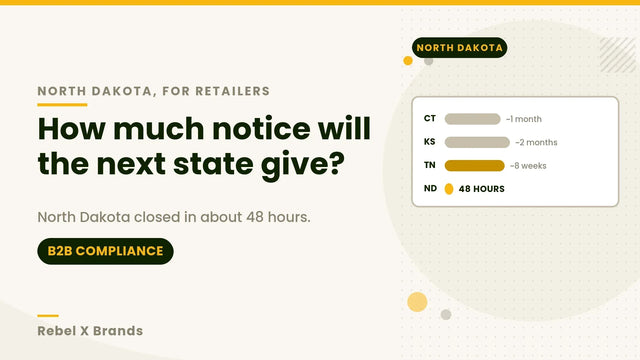
Our wholesale buyer portal auto-blocks orders to those six. Verification happens at order entry, not fulfillment, so you don't waste three days waiting for a cancellation email.
Counties and Cities That Banned It Anyway
A handful of states are clean on paper but messy at the county or municipal level. Watch these:
- Florida Sarasota County bans it. Rest of the state's fine.
- California San Diego, Oceanside, plus a handful of unincorporated counties.
- Illinois Jerseyville and Alton banned it. Chicago locked it to 21+.
- Mississippi Dozens of cities and counties moved before the state did anything.
- New Hampshire Statewide 18+ minimum, and a few towns push for full bans every cycle.
If you operate in any of these, check the actual county and the actual municipal code. A single city council vote can rewrite your inventory plan overnight.
21+ States and the KCPA
Then there's the KCPA: Kratom Consumer Protection Act. Texas, Arizona, Georgia, Nevada, Oklahoma, Utah, Virginia, Colorado, and growing. KCPA states force 21+ ID at point of sale plus tight rules on labeling, testing, and supplier documentation. The FDA also publishes ongoing guidance for sellers that overlaps with KCPA enforcement: fda.gov/food/dietary-supplements. Worth checking quarterly.
In a KCPA state, your supplier has to prove AKA-aligned GMP, batch COAs, and label conformity. Rebel X ships all three by default. Smaller suppliers? Often a shrug and a "we're working on it."
What a Compliant Order Actually Looks Like
Every Rebel X wholesale shipment includes three things:
- A batch-level COA. Mitragynine, 7-hydroxymitragynine, heavy metals, microbials, aflatoxin. The whole panel.
- Labeling that satisfies the strictest KCPA state you're shipping into, so one SKU works across your whole map.
- Ship-to verification at order entry. ZIP, county, state, all checked before submission.
If you want the deep pharmacology background on mitragynine, the NIH National Library of Medicine has a solid primer: ncbi.nlm.nih.gov. Not light reading but useful when a customer asks technical questions.
When a State Flips Mid-Year
Three moves, in order:
- Subscribe to AKA state-law alerts. Free, fast, surprisingly thorough.
- Check your on-hand inventory. Can you sell it through before the effective date, or do you need to ship it back?
- Pause the affected state in your wholesale account. The Rebel X portal does this automatically when a change is logged.
Bottom Line
State-level kratom compliance is operational discipline. Not a checkbox. Pick a wholesaler that blocks restricted ship-to at the point of order, hands you COAs in a portal, and stays AKA-aligned. A safe starter SKU while you're building the program: King K Gold Liquid Kratom Extract. Top mover, MAP-protected, current COA in every case.
Apply for a Rebel X wholesale account. You'll get the buyer portal with restricted-state blocking, the COA library, and AKA-aligned paperwork on every order.