The kratom age limit in Minnesota moved from 18 to 21 on 1 August 2026, and it covers purchase and possession both. If one of your people rings a sale to a 20 year old, the statute says that person is guilty of a gross misdemeanor. Read that again. It is not a licensing action, because kratom has no license in Minnesota. It is not an administrative fine your insurer absorbs and your accountant writes off. It is a criminal exposure that lands on the human being who touched the transaction, and on whoever set the policy that allowed it. This is the operational version of the story: what you change at the counter, what you change in the back office, what you change on the shelf, and what you change before the next purchase order goes out.
What the kratom age limit actually says, word for word
Minnesota amended Minn. Stat. Sec. 152.027, subdivision 7. The bill was HF 3453 in the House, with SF 3704 as the Senate companion. It passed the House 127 to 5 on 20 April 2026 and the Senate 56 to 10 on 23 April 2026, Governor Tim Walz signed it on 5 May 2026, and it became 2026 Minnesota Laws Chapter 63. You can pull the whole record yourself from the HF 3453 status page on the Minnesota House site.
Here is the operative language, with the old age struck out and the new one in its place:
"(a) A person who unlawfully sells any amount of kratom or a substance that contains mitragynine or 7-hydroxymitragynine to a person under the age of 21 is guilty of a gross misdemeanor."
"(b) A person under the age of 21 who unlawfully possesses any amount of kratom or a substance that contains mitragynine or 7-hydroxymitragynine is guilty of a misdemeanor."
"EFFECTIVE DATE. This section is effective August 1, 2026, and applies to crimes committed on or after that date."
Note what is not in that language, because staff briefings keep getting this backwards. Chapter 63 struck 18 and wrote 21, and that is the entire amendment. The offense levels did not move with the age. Under-age sale was a gross misdemeanor before 1 August 2026 and it is a gross misdemeanor now, and under-age possession was a misdemeanor then and is one now. What changed is who counts as under-age: three years of buyers who were lawful customers on 31 July 2026.
Now look at the phrase that decides your shelf. Not "kratom products". Not "kratom" alone. The words are kratom or a substance that contains mitragynine or 7-hydroxymitragynine, which means the rule follows the compound, not the category and not the word printed on the front of the package. A kava branded relaxation drink that has mitragynine blended into it is covered. So is a two ounce shot, a seltzer, a gummy, a tablet, a tincture, and anything else on your counter whose ingredient panel or certificate of analysis shows either alkaloid, regardless of how the brand markets itself or which planogram slot it occupies in your store.
That single sentence is why most operators will get this wrong. Your point of sale knows product categories. Your clerk knows the word kratom. Neither of them knows chemistry, and the statute is written in chemistry.

Part one: five things you change at the counter
1. Reset the age prompt to 21 and delete the old rule
Most systems let you keep more than one age rule alive at once. That is the trap. If an 18 rule is still sitting in the product file next to a new 21 rule, sooner or later a SKU gets tagged against the wrong one and nobody notices until it matters. Delete the 18 rule outright rather than leaving it dormant. If your system computes a cutoff birthdate, confirm it is computing against 21 and spot check it: on 7 August 2026, anyone born after 7 August 2005 is under 21.
2. Make it no ID, no sale, and take the override away
Every POS has a manager override, and every manager override eventually gets used by someone who is tired, busy, or being argued with. Restrict the override on covered SKUs to the owner's card, or turn it off entirely for that product group. You are not trying to catch a determined fake. You are trying to remove the moment where a person has to make a judgment call at 6:40 on a Friday evening with four people in line behind the one holding a beat up ID.
3. Write down which IDs you accept, and which you do not
Keep it short and put it where the clerk can see it. Unexpired government issued photo identification: state driver's license, state identification card, US passport or passport card, military identification, tribal identification. Not a photograph of an ID on somebody's phone. Not a school identification card. Not an expired license, no matter how good the story is. Vertical format licenses deserve a second look rather than an automatic refusal: the holder may have had a birthday since the card was printed, and the date governs, not the orientation.
4. Write the refusal script before you need it
Three sentences, printed, taped inside the register drawer. Something like: "I can't sell this to you without a valid ID showing you're 21 or older. That's state law in Minnesota as of 1 August 2026, and it's a criminal charge for me personally, not a fine for the store. I'm happy to help you with anything else." Your staff should never have to invent that language under pressure. People who improvise refusals either cave or escalate, and both outcomes cost you.
5. Log the refusals, not just the sales
This is the cheapest evidence you will ever create, and almost nobody does it. A spiral notebook by the register works: date, time, register number, product category, clerk initials. Nothing identifying about the customer: no names, no ID numbers, no photographs. Twelve entries a month in a notebook is a documented pattern of enforcement, and a documented pattern of enforcement is a very different conversation with a county attorney than a shrug and a policy binder nobody ever opened.
Part two: four things you change in the back office
6. Re-tag your product file by compound, not by category
Export your SKU list. Go through it once, properly, with the ingredient panels and the certificates of analysis in front of you, and flag every single item where mitragynine or 7-hydroxymitragynine appears at any level. That flag, and not your merchandising category, is what should drive the 21 prompt. If a product is in your "kratom" category it almost certainly needs the flag. The reverse does not hold, and that asymmetry is the entire compliance problem in one line.
7. Go and physically look at the drinks cooler
This is where operators lose money on this rule, and it is worth doing with your own eyes rather than delegating it. The ready to drink shelf is full of products branded as kava, as botanical blends, as relaxation or focus or calm, and a meaningful number of them have mitragynine blended in alongside whatever is on the front label. Minnesota's statute does not care what the front label says. If the panel or the COA shows mitragynine, that bottle is gated at 21 in your store, and the fact that your supplier calls it a kava drink is not a defense available to the person who rang it up.
8. Put the training on one page and get it signed
One sheet. What changed, the effective date of 1 August 2026, the ID rule, the refusal script, and a plain sentence saying that selling to someone under 21 is a gross misdemeanor for the individual who makes the sale. Then a line for printed name, signature and date. Have everyone who touches a register sign it, including part timers and including you. Keep the signed sheets. Ask your counsel how long to keep them.
9. Fix online orders shipping into Minnesota
A checkbox that says "I am 21 or older" is an age gate. It is not age verification, and a cheap plugin is no reason to confuse the two. Your realistic options are to block Minnesota ship-to addresses for covered SKUs, to add a third party identity verification step at checkout, or to require adult signature on delivery and pay for it. I am not going to tell you which of those satisfies a Minnesota prosecutor, because I genuinely do not know and neither does anyone else selling you software. Ask a lawyer licensed in Minnesota. What I will say is that doing nothing is the one option with no argument behind it at all.
Part three: three things you change on the shelf
10. Signage at three points, not one
Door, shelf edge, register. It costs about forty dollars to print and laminate, it takes twenty minutes, and it does two useful things. It gives your clerk a physical object to point at during an argument, which de-escalates roughly half of them. And it is visible evidence, in any photograph anyone ever takes of your store, that the policy existed and was communicated before the transaction rather than invented afterward.
11. Move covered SKUs behind the counter or into a gated fixture
Remember that subdivision (b) makes possession by a person under 21 a misdemeanor in its own right. That means a 19 year old standing in your aisle holding a covered product is now a problem happening inside your store, whether or not anybody ever rings it. Behind the counter is simplest. A locked or gated fixture works. An open shelf at the front door, next to the phone chargers, is the version that will eventually generate a story you do not want.
12. Existing stock is not contraband, so do not panic sell it
Nothing on your shelf became illegal on 1 August 2026. Kratom remains legal to sell in Minnesota to adults aged 21 and over, this was not a scheduling action, and kratom is not a controlled substance in the state. You do not have to destroy anything or ship anything back, and be skeptical of any distributor offering to take Minnesota inventory off your hands at a discount. Gate it and keep selling it. The difference between a regulation and a prohibition, in cash terms, is exactly this paragraph.
Part four: two things you change before the next order
13. Ask for alkaloid numbers on the purchase order, not after the pallet lands
If the law follows the compound then your paperwork has to follow the compound too. Put it in writing on the PO: a lot specific certificate of analysis, with mitragynine and 7-hydroxymitragynine both reported, for every item you intend to put on a Minnesota shelf. Suppliers who can produce that on request are the ones worth keeping. Suppliers who send you a two year old PDF for a different lot are telling you something useful about how the rest of the relationship is going to go. We publish our own certificates on the Rebel X lab results page so you can read them yourself rather than take a claim on faith, and you should hold every supplier you buy from, including us, to the standard of showing you the actual numbers for the actual lot.
14. Write down the date you did all of this
One page, dated, kept somewhere you can find it. What you changed, when you changed it, who signed the training sheet, what your ID policy is, when the signage went up. Nobody enjoys writing this memo and it takes about fifteen minutes. It is also the only thing standing between "we have a policy" and "we can demonstrate we had a policy in force on the day in question", and those two sentences have very different values in a room where somebody is deciding whether to charge one of your employees with a crime.
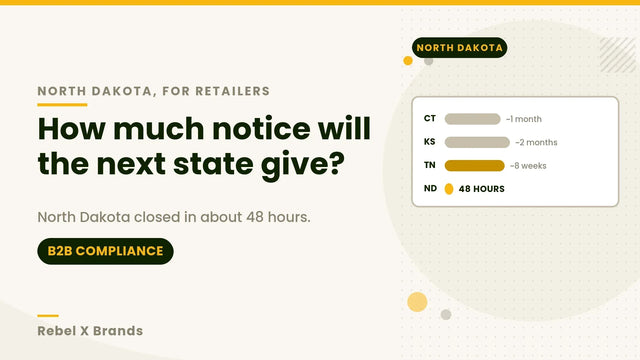
Minnesota gave 88 days. North Dakota gave about 48 hours.
Here is the framing point, and then we will move on. Chapter 63 was signed on 5 May 2026 and took effect on 1 August 2026, which is 88 days of notice. In the same season, North Dakota's Executive Order 2026-04 banned sale, purchase and possession outright, effective 5 p.m. on 5 August 2026, with roughly two days of warning. That order is temporary. It runs thirty days, it lapses around 4 September 2026, and Governor Armstrong has called a special legislative session for 2 September 2026 to decide whether prohibition goes into North Dakota statute. Two states, one month apart, moving in opposite directions at wildly different speeds. If you sell into Minnesota it is worth bookmarking the House Public Information New Laws service, which summarizes what each session actually enacted and when it takes effect, because it is free and it is upstream of every paid tracker you have ever been sold.
The operational lesson is not "regulation good, prohibition bad", which is a lobbying position rather than a purchasing decision. It is that a regulated change is a project you can schedule, budget and absorb, while a prohibition is a write off that arrives before your next delivery does. Minnesota cost most operators a POS ticket, some printing and an afternoon. North Dakota froze every covered SKU in the state on two days of notice.
The part of North Dakota that should drive your buying is not the order, though. It is the Board of Pharmacy emergency rule that scheduled 7-hydroxymitragynine as a controlled substance for roughly 180 days, which outlasts the order by months. Three clocks are running in one state: a thirty day prohibition that lapses around 4 September 2026, a special session on 2 September 2026 that decides whether prohibition becomes statute, and a 7-OH scheduling rule that keeps running whatever those two do. Read that as a purchasing instruction. Leaf and low-alkaloid stock has a plausible route back onto a North Dakota shelf in September. Concentrated 7-OH stock does not, and depth on those SKUs is depth against the one clock that is not ticking down.
| Change | Instrument | Signed or issued | In force | Notice period |
|---|---|---|---|---|
| Minnesota: kratom purchase and possession age raised from 18 to 21 | 2026 Minn. Laws ch. 63 (HF 3453, SF 3704) | 5 May 2026 | 1 August 2026 | 88 days |
| North Dakota: temporary 30 day prohibition on sale, purchase and possession, with a special session on 2 September 2026 to decide whether it becomes statute | Executive Order 2026-04 | August 2026 | 5 p.m., 5 August 2026, lapsing about 4 September 2026 | About 48 hours |
| North Dakota: 7-hydroxymitragynine scheduled as a controlled substance | Board of Pharmacy emergency rule | August 2026 | About 180 days, so it runs past both the order and the special session | Effectively none |
| Rhode Island: prior ban repealed, market reopened under a licensed framework at 21 and over | Repeal plus licensing statute | April 2026 | Rollout during 2026, specific dates not confirmed here | Months |
Treat the Rhode Island row as directional rather than exact. We have confirmed the repeal and the shape of what replaced it: four license classes, a 21 and over floor, per serving caps of 150 mg mitragynine and 1 mg 7-hydroxymitragynine, heavy metal limits and packaging rules. We have not confirmed each phase-in date, so check those with the state before you commit stock.

What kratom compliance looks like when nobody is issuing licenses
Most age restricted retail comes with a regulator attached. In Minnesota, alcohol and tobacco retailing sits under the Department of Public Safety, whose Alcohol and Gambling Enforcement Division handles licensing and runs compliance checks. You know the drill there. An inspector arrives, a check is run, a violation is written, a license is at risk, and the whole exposure is administrative and insurable and survivable.
Kratom has none of that in Minnesota, and I want to be precise about it: the Alcohol and Gambling Enforcement Division does not regulate kratom, the Minnesota Department of Health does not regulate the sale or possession of kratom, and Chapter 63 attached no licensing, testing or labeling regime to the age change. There is no state inspector coming with a clipboard and a checklist for your kratom shelf.
Operators keep hearing that as good news. It is not. What it actually means is that there is no low stakes failure mode. In alcohol you fail a compliance check, you pay, you fix it, you carry on. Here, the first time anyone examines your age verification practice may well be after a charge has already been filed against one of your employees, and the evidence in the room will be whatever records you happened to keep. That is the reason items 5, 8 and 14 on this list exist. Nobody is going to audit you into readiness. You have to document yourself into it, unprompted, in advance.
What this actually costs
Round numbers for a single storefront, because vague advice is worthless. A POS configuration change is usually free if you do it yourself and one support ticket if you do not. Printed and laminated signage for three points runs about forty dollars. A one page training document costs you the time to write it once, then five minutes per employee to walk through and sign. Re-tagging a product file of two hundred SKUs against ingredient panels and COAs is the real cost, and honestly it is a half day of somebody's attention, a full day if your supplier documentation is scattered across three inboxes.
So call it under two hundred dollars and one working day. Against a gross misdemeanor, which under Minn. Stat. Sec. 609.03 carries up to 364 days and a fine of up to $3,000 for the individual convicted, plus the legal fees, plus the staffing hole while it plays out. The arithmetic is not close, and it is not the kind of arithmetic that gets better if you wait.
What to do first
If you only do three things, do these. Reset the POS prompt to 21 and delete the old rule. Walk the drinks cooler with the ingredient panels and flag every SKU containing mitragynine, because that is where the surprise is hiding. Print the one page training sheet and get signatures on it before the next weekend shift.
After that, widen the lens. Minnesota is one state and the map underneath this industry is still moving, so if you ship across state lines, our state by state kratom compliance guide for retailers is the place to check your other markets before your next order rather than after it. And if you want a supplier who will send lot specific alkaloid numbers without being chased for them, and who will tell you plainly when a state has moved, you can apply for a wholesale account. We would rather sell you the right depth in an unsettled state than the biggest order you will take.
One last thing, and it is the part the industry is bad at saying out loud. Age gating is our own stated position. We have argued for it in front of legislators, and every trade group in this category has done the same. When a state actually does it, and does it with three months of notice and a bipartisan vote of 127 to 5, the only honest response from a retailer is to implement it properly and quickly. Complaining about the one form of regulation we asked for is how you end up with the North Dakota version instead: an order in force inside 48 hours, and a legislature asked to ratify it afterwards on 2 September 2026.
This article is operational guidance for retailers and wholesalers. It is not legal advice, and nobody at Rebel X Brands is your lawyer. Statutes, local ordinances and enforcement practice vary by state, county and city, they change without much warning, and the only person who can tell you what your specific obligations are is an attorney licensed in your jurisdiction. Confirm everything here with your own counsel before you rely on it. We have not stated penalties for states other than Minnesota because we have not verified them. These statements have not been evaluated by the Food and Drug Administration. These products are not intended to diagnose, treat, cure or prevent any disease, and kratom is not approved by the FDA for any use.